(Reading Gratitude Journal #2) The Sparrow
by Mary Doria Russell
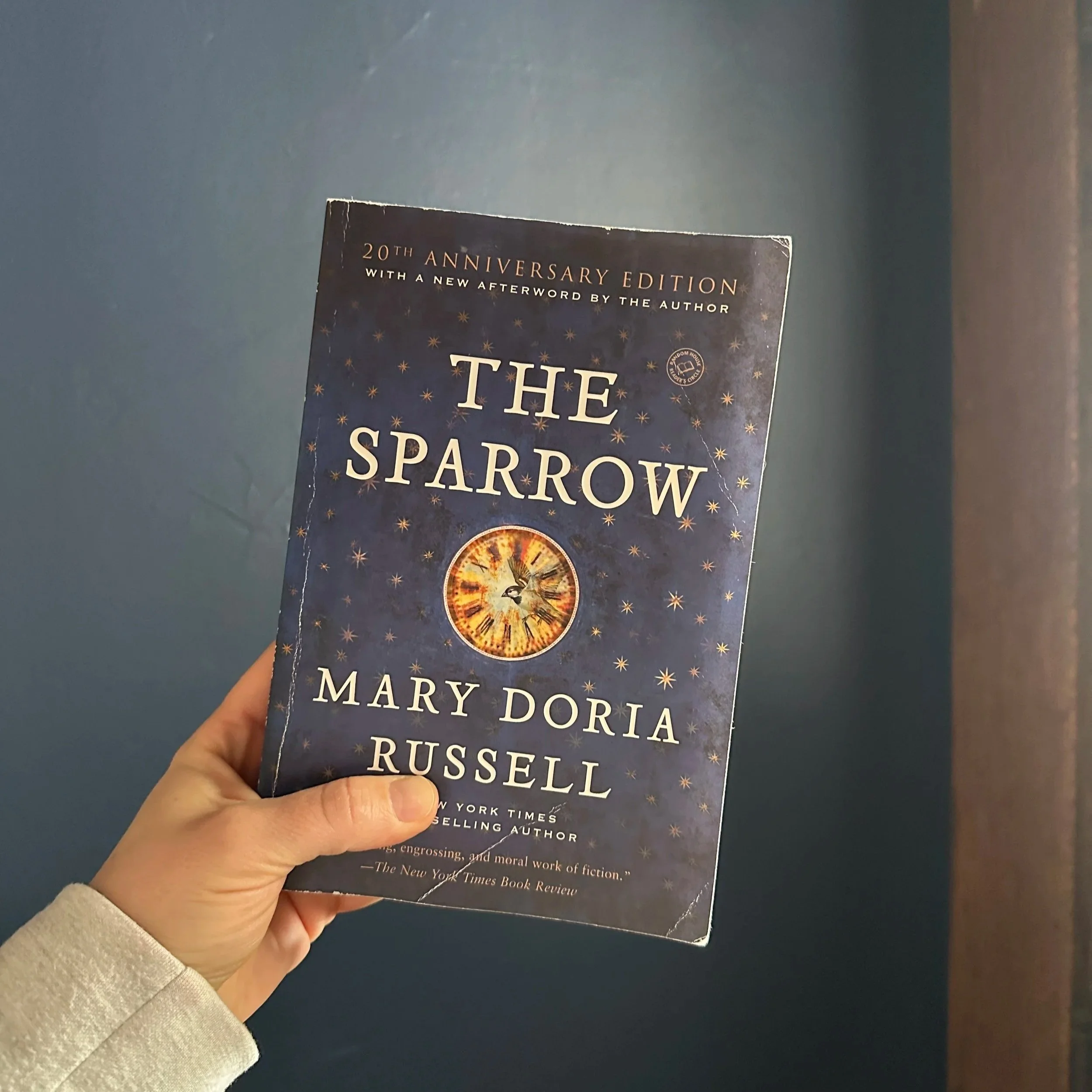
Welcome back to my Reading Gratitude Journal, where I celebrate only good things in the books I’m reading.
I’ll be real with you--I’m behind on writing these. It’s been weeks since I finished this sweeping science fiction story of a Jesuit mission to make humanity’s first contact with alien life. But here we are! And here’s why I’m grateful for The Sparrow by Mary Doria Russell…
A science fiction classic?
While we were living with my parents during our home renovation, my mom made a gesture toward The Sparrow. It was one of those books that she assumed I had read before, given how celebrated it was in 1996 when it was first published.
Back then, Colleen McCullough from the New York Times called it “a superior kind of science fiction.” My mom’s copy was a 20th anniversary edition after all - they don’t hand those out to just anybody.
I’ll admit that it feels good to feel like I’m well-versed in the classics. Proving that you can take the girl out of the English department, but you can’t take the English department out of this girl.
What sci-fi does best
The Sparrow has tremendous worldbuilding and imagination. It’s clear there’s a lifetime of research behind it. So impressive.
And speaking of research…
Jesuit Synchronicity
I was reading The Sparrow, which is Jesuits in space, at the same time I was researching Chicago history for Ring of the Axe.
In City of the Century, Donald Miller describes how that “generation of Jesuit missionaries were explorers and men of science, eager to travel to unknown lands and send back fact-filled accounts of climate, geography, soil conditions, plant and animal life, river currents and lake tides, and the habits and customs of the native peoples they encountered” (930).
And honestly the Jesuits on Rakhat were cut from the same cloth as the Great Lakes explorers. I love it when the connections start syncing up between my reading.
Character building and relationships
Even though The Sparrow has plenty of science and anthropology and botany and whatnot, there’s a real core of human relationships. Several times, the characters are faced with turning points about what they will be to each other: friend, lover, mother, sister, priest. And their decisions are so poignant.
Uncannily accurate predictions around AI
Another characteristic of sci-fi is that it often correctly predicts how certain technologies will affect our lives. Sofia Mendez is literally out there coding AI programs explicitly to replace human efforts. If someone wrote it now, frankly it would feel too on the nose.
Patient, restrained storytelling
Emilio Sandoz shows up surrounded by rumors and recovering from a gruesome injury in chapter 1. It’s not until the end that you truly understand why. Sustaining that interest and suspense for almost 500 pages knocks my socks off.
A fated, fateful, inevitable conclusion
I like a story with a sense of inevitability. I try to write them myself, searching for that moment where you think “of course it had to be this way.”
When the friends in The Sparrow first discover alien music being reflected back to earth, they all look at each other and realize they have the exact skillsets necessary to be the crew to meet this culture.
The conclusion of the story comes crashing through in the same way. It’s pretty devastating, but it’s a testament to the character development and plotting.
Sequel optional, thank goodness
The Sparrow already had its hooks in me by the time I learned there was a SEQUEL. I was not happy. I hadn’t signed up for that.
However, the wisdom of Reddit advised me that I would not need to read it to still have a deep & complete experience, and they were right. I’m stopping my journey with The Sparrow here, and thankful that I did!
